
Common ERP Integration Challenges and How to Avoid Them
Common ERP Integration Challenges and How to Avoid Them Table of Contents Introduction Why ERP Integration Challenges Keep Surfacing in...
Read More →
At 6:30 a.m., a global retailer received an urgent call from a major customer. A critical priority shipment had not arrived at the distribution center. The warehouse team insisted the goods had already been dispatched. The transportation provider claimed the shipment was still in transit. Customer service had no real-time updates, and management had no clear answer.
What followed was a chain reaction: delayed deliveries, frustrated customers, emergency shipping costs, and hours spent searching for information across disconnected systems.
Such high risks situation is not unusual in supply chains that involve multiple suppliers, carriers, warehouses, and technology platforms. When data is fragmented, businesses struggle to understand what is happening across their operations.
According to a 2024 survey by Maersk, Supply Chain Operational Visibility was ranked as the number one trend among logistics decision-makers, with 77% of companies prioritizing investments in visibility technologies.
This growing focus highlights a critical business reality: organizations can no longer rely on delayed reports, spreadsheets, siloed systems, and generic software. They need real-time insights across every stage of the supply chain.
And this is exactly where tailored supply chain technology plays a transformative role in the customer-centric supply chain ecosystems.
End-to-End Supply Chain Visibility refers to the capability of a business to monitor, track, and act on real-time data across every node of its ecosystems. From sourcing raw material, optimizing resources to last-mile delivery- in the supply chain, visibility means more than knowing where a shipment is. It means understanding:
The traditional supply chain operates in silos- reporting increased issues with disconnected systems, where information doesn’t flow and the team are left in the dark. But, organizations that have adopted bespoke Supply Chain Visibility Technology solutions for unique operational risks are experiencing greater visibility across the ecosystem, enabling performance and speed with precision.
Operational visibility isn’t just a feature, it is the foundation of a high performing supply chain. Connect with Lynqcore to build a bespoke operational visibility solution unique to your business.

1. Real-time Tracking
Modern supply chain platforms use IoT sensors, GPS, and cloud-based dashboards for intelligent visibility into goods movement. Whether tracking fleet operational visibility for a logistics provider or monitoring inbound shipments for a manufacturer, real-time data boosts operational efficiency. Automation reduces human labor in supply chain processes by removing the guesswork.
Companies using real-time visibility platforms have experienced up to a 20% reduction in operational delays and a 30% improvement in disruption response times, according to 360 Research Reports.
This real-time operational data visibility allows decision-makers to respond to port congestion, weather disruptions, or supplier delays within hours, not days.
2. Artificial Intelligence and Predictive Analytics
Reactive systems are obsolete in the hyper competitive business scenario. The competitive edge now belongs to companies that could predict disruptions before they happen. To simply put, AI-powered simulation tools allow companies to model potential disruptions in supply chains. If you fear your business is losing the edge, partner with the right automation solution provider today!
Businesses that have adopted AI-driven technology enjoy 97% greater profits. Integrating AI into your supply chain enables smarter re-routing and intelligent decision making that could be a significant differentiator to your precise success story.
3. Improved Warehouse Operations
Poor warehouse operations are often the last-mile culprit in supply chain failure. Without operational data visibility inside a warehouse, critical nodes such as inventory counts, order picking rates, inbound shipment timelines, everything is flying blind.
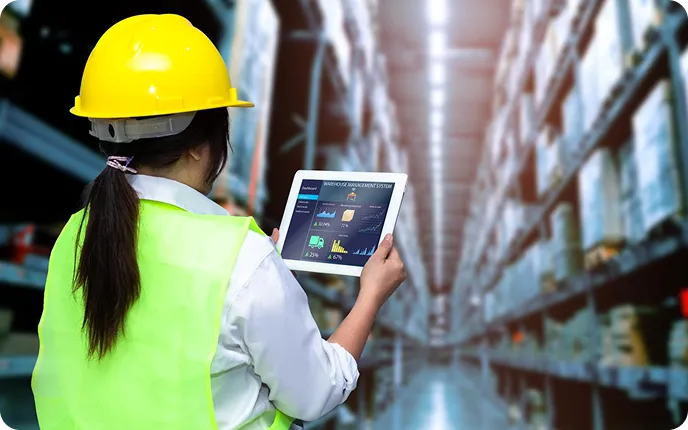
Integrating a custom-built Supply Chain Management Technology solves this through Warehouse Management Systems (WMS) embedded with broader visibility platforms. These systems track inventory in real time, automate the order of operations for picking and packing, and synchronize with fleet management- smoothly aligning outbound shipments with carrier availability.
4. Multi-channel Supplier Transparency
Most supply chain complexities don’t originate from Tier-1. Problems can quickly escalate from Tier-2 and Tier-3 sources that are invisible to businesses.
Advanced supply chain technology platforms now aggregate data across multiple supplier tiers, creating the kind of deep operational data visibility that was unimaginable even a few years back.
By investing in multi-tier visibility tools, businesses now have an accurate view of supply risk, compliance, and capacity, which effortlessly creates a trusted, confident presence in a volatile global environment. Explore how.
5. Last-Mile Intelligence
For logistics-heavy business processes, fleet operational visibility determines the ROI. Modern telematics platforms not only track vehicle location but also driver behavior, fuel consumption, and estimated arrival times, all feeding into a single operations management dashboard.
This level of fleet visibility enables dynamic rerouting during traffic disruptions and precise optimization in modern-day operations and supply chain management.
This is how technology adoption is rapidly revolutionizing the global supply chain by addressing potential issues. But businesses that are still thinking about it are losing dollars every minute.

Supply chain without end-to-end operational visibility is a huge business risk. Streamlining every node in logistics is business-critical to ensure the team has real-time access to information across transportation, warehouses, and customer fulfilment. As missing out on a single node, can create a maze of delays and inefficiencies.
With the supply chain visibility market on track to surpass $10 billion within a decade, the question is no longer whether to invest in supply chain technology-it’s how fast you can get there.
Supply Chain Technology refers to digital tools and systems that help organizations manage, track, and optimize the flow of goods, information, and resources across the supply chain.
Operational Visibility enables businesses to monitor real-time activities, identify disruptions early, improve decision-making, and enhance overall efficiency.
It provides real-time inventory tracking, workflow optimization, labor management, and improved inventory accuracy for faster and more efficient fulfillment.
ERP systems, WMS platforms, TMS solutions, IoT devices, AI-powered analytics, and supply chain control towers all contribute to operational data visibility.
Manufacturing, retail, logistics, pharmaceuticals, and automotive sectors tops the adoption-but any industry managing complex supplier networks, warehouse operations, or last-mile delivery stands to gain significantly.