
What Is an Order Management System (OMS)? A Practical Guide To Smarter Operations
Table of Contents
- Introduction
- What is an Order House Management System?
- Why Order Tracking and Inventory Visibility Have Become Non-Negotiable
- Retail Order Management Systems: Built for Omnichannel Complexity
- Cloud-Based Order Management Software for Retail and How It is Replacing Legacy Systems
- Key Factors to Look for in an Order Management System
- Final Words
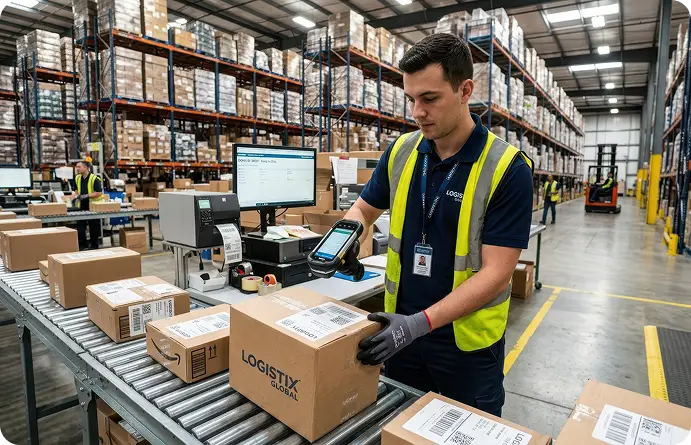
In the U.S., e-commerce sales reached an estimated $340.2 billion in Q2 2026, accounting for 17.1% of total retail sales for the quarter- the numbers showing how quickly digital ordering continues to influence the retail and fulfillment landscape.
However, most of the time scaling orders doesn’t sync with the operations.
For an inventory business, every order impacts operational decisions, like the inventory availability, locations to be delivered, last-mile report, situations if the item or recipient is unavailable, and various such factors.
Such real situations explain the reason behind the growing demand for Order Management System (OMS), way bigger than just an order-processing tool. A modern OMS acts as an operational layer connecting every touchpoint of the inventory ecosystem, while managing people, data, and processes connected to it.
The platform is specifically crucial for businesses operating across multiple channels and locations. Its real value is not simply processing orders faster, but creating a connected flow from customer demand to fulfillment.
In this detailed guide, we unveil the hidden potential of Inventory Control and Order Management Systems that businesses can leverage to stay competitive and agile.
What is an Order House Management System?
An Order Management System (OMS) is programmed to track and coordinate an order processing right from the moment it’s placed to the final-mile- and often including returns and exchanges as well.
An OMS acts as the central nervous system connecting sales channels, warehouses, carriers, and customer service teams. This enables every team to stay on the same page regarding real-time shipping updates.
At its core, an OMS workflow orchestrates every step automatically, such as order capture, validation, inventory allocation, order routing, fulfillment, shipment, and delivery tracking. It effortlessly tracks an order journey regardless of whether it was placed from a website, online marketplace, retail POS system, or a B2B sales portal.

Why Order Tracking and Inventory Visibility Have Become Non-Negotiable
American consumers have been molded by the largest retailers to expect accuracy through real-time stock visibility, honest delivery windows, flexible pickup and return options, and consistent pricing notifications- no matter where they shop from.
When a business can’t deliver on any one of these, the cost shows up real fast in cart abandonment, support tickets, and reviews.
This is where order tracking software becomes imperative. A modern OMS doesn’t just process an order; it gives real-time process visibility to both businesses and customers. That transparency reduces the chaos and confusion, which can directly cause a massive slide in trust and retail economics.
Inventory control and order management are really two sides of the same coin. An OMS that isn’t tightly synced with real-time inventory data will eventually promise something the warehouse can’t deliver. That’s the oversold scenario above, and it’s one of the most common (and most preventable) causes of customer churn in ecommerce and wholesale distribution alike.
Retail Order Management Systems: Built for Omnichannel Complexity
A retail order management system has to do more than the basics. Today’s shoppers move fluidly between browsing on a phone, buying on a laptop, picking up in-store, and returning to a different location entirely.
To complement this consumer paradigm shift, retailers are increasingly turning their physical stores into fulfillment nodes. New parameters like ship-from-store, buy-online-pickup-in-store (BOPIS), and same-day delivery are becoming more normal than premium standards.
None of that is possible without an OMS that can intelligently route each order to the best-positioned inventory, whether that’s a distribution center, a regional warehouse, or the store two miles from the customer’s house. Done well, this kind of intelligent order routing can reduce shipping costs by a meaningful margin while still giving customers their desired delivery speed and flexibility.
This is also why B2B commerce can’t be treated the same way as B2C inside an OMS. Contract-specific pricing, negotiated fulfillment terms, and complex approval workflows all have to be respected, while the system still optimizes for margin and speed. With B2B ecommerce volumes climbing sharply globally, businesses that haven’t modernized this layer are quietly losing their ground to competitors.
Cloud-Based Order Management Software for Retail and How It is Replacing Legacy Systems
A decade ago, order management often meant a patchwork of on-premise software, manual exports, and someone reconciling spreadsheets at the end of the day.
That yesteryear approach doesn’t complement today’s fast-scale inventory or a peak shopping season demand. To bridge the widening gap between demand and supply, cloud-based order management software for retail has become the default platform that scales elastically with order volume, updates in real time across every connected system, and doesn’t even require a server room to maintain. It also makes it far easier to plug in new integrations, a new marketplace, a new carrier, a new point-of-sale system- without a multi-month IT project every time.
Just as important, cloud OMS platforms increasingly connect directly with ERP, WMS, and TMS systems, therefore closing the data silos across systems. When quote-to-order, inventory, and fulfillment data live in sync, teams stop firefighting and start making decisions based on what’s actually happening on the ground.
Having said that, it is equally important to choose the right OMS for your operation to derive the best result and without paying extra for idle features and capabilities.
Key Factors to Look for in an Order Management System
1. Centralized Process Visibility
Teams must have end-to-end visibility of the order journey without manually searching across multiple systems.
2. Intelligent Order Routing
Advanced OMS with ML-driven features provides accurate data- enabling intelligent order routing overlooking time-sensitive fulfillment requirements.
3. Order Tracking Capabilities
Customers increasingly expect visibility after checkout. Internal teams also need to know whether an order is processing, delayed, shipped, delivered, or stuck.
4. Seamless Integration
An OMS should work with the broader technology ecosystem and scalable architecture, including ecommerce platforms, ERP, WMS, TMS, POS, payment systems, carriers, and 3PL platforms.
For growing businesses, considering the above parameters are enough to make a confident approach and watch your retail business growing.

Final Words
Order management has quietly become one of the clearest differentiators between businesses that scale smoothly and businesses that hit a ceiling. It’s rarely the flashiest part of the technology stack, but it’s the layer that determines whether a growing order volume becomes a growth story or an operational headache.
As order complexity keeps climbing across every channel, the businesses investing in connected, accurate, real-time order management today are the ones building the operational foundation to compete tomorrow. If disconnected systems and manual workarounds are already costing time, accuracy, or customer trust, the smartest next step is a clear-eyed look at what a properly designed order management strategy could fix- starting with a conversation to find the hidden gaps and solutions.
Frequently Asked Questions
What's the difference between an Order Management System and inventory management software?
Inventory management software tracks stock levels and locations. An OMS goes further, orchestrating the entire order lifecycle- capture, validation, routing, fulfillment, and tracking- often pulling inventory data in as one input among several.
Do small and mid-sized businesses need an OMS, or is it just for large retailers?
Any business selling across more than one channel benefits from an OMS. The complexity that causes overselling, shipping errors, and support overload shows up at a small scale too often sooner than expected as order volume grows.
How does an OMS integrate with existing ERP or WMS systems?
Most modern, cloud-based OMS platforms are built with open APIs specifically to sync with ERP, WMS, and TMS systems, so inventory, financial, and fulfillment data stay consistent across the business without manual reconciliation.
How long does it typically take to implement an Order Management System?
Timelines vary based on the number of integrations, sales channels, and existing data quality, but most implementations move faster when a proper diagnostic and design phase happens before any software is deployed.
Recent Blogs

Common ERP Integration Challenges and How to Avoid Them

2 Responses